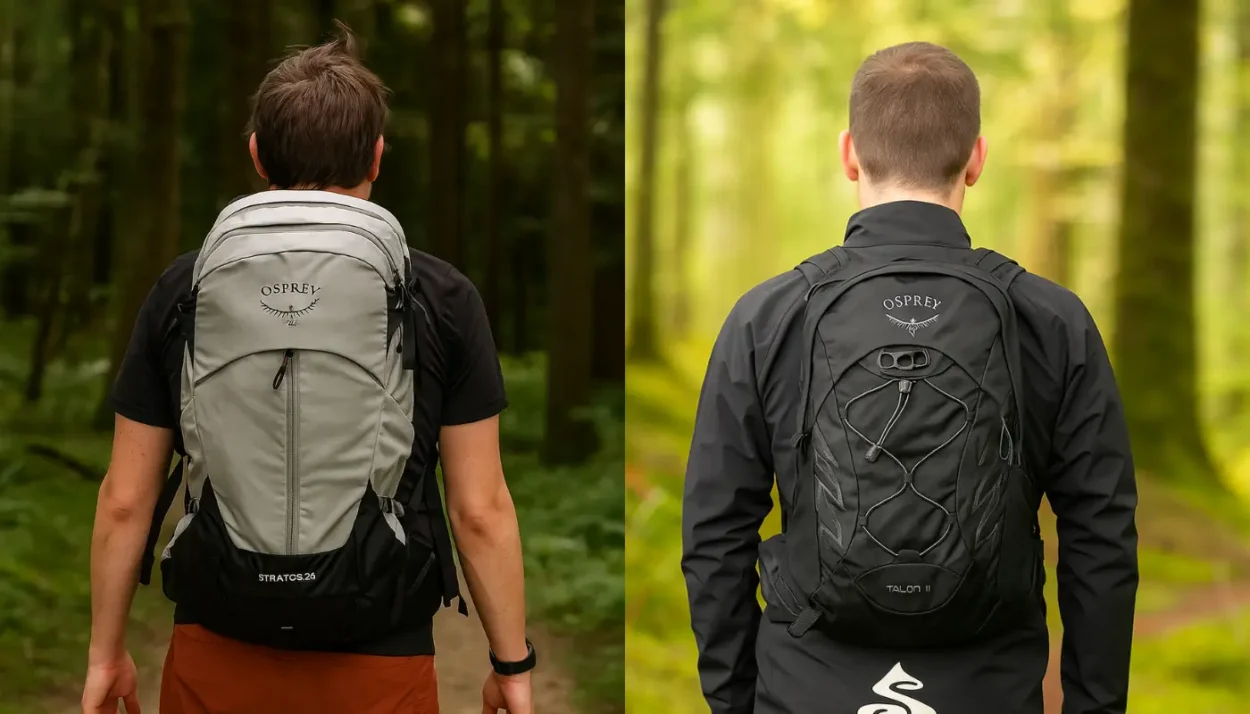
Today I’m comparing two of Osprey’s most popular day-hiking packs — the Stratos and the Talon. Both come in men’s and women’s versions and target hikers who want performance without excess weight.
I wanted to see how they differ in real use — fit, ventilation, and comfort on the trail. On paper, they look similar, but the feel and purpose of each pack are completely different.
Key Factors for Comparison
When I compare these two packs, I’m not looking at color or style. I care about how they carry on a real hike. For me the important points are back ventilation, frame support under load, organization and access to gear, total weight, and what’s included out of the box, like a rain cover or hydration setup.
Breathability matters because a sweaty back will ruin comfort fast. A pack can feel great for the first mile and terrible by hour five if the suspension isn’t right. The hip belt has to carry the weight, not my shoulders.
Access matters too — I want to grab a bottle, jacket, or map without digging through the whole pack. Weight tells me how fast I can move. Extras decide value. That’s how I judge Stratos vs Talon.
Fit, Harness & Torso Adjustment
Both the Stratos and the Talon lines let me adjust torso length, so I’m not locked into a fixed frame. I can slide the harness to sit where I want it on my back instead of forcing my spine to match the pack.
The Talon (and Tempest in the women’s fit) uses a lighter harness with thinner padding and more flexible shoulder straps. It moves with me and doesn’t fight my hips when I’m scrambling, biking, or hiking fast with a light load.
The Stratos (and the Cirrus women’s version) feels more built-up through the belt and shoulders. The hip belt is thicker and does more of the work instead of leaving it to my lower back. Under a heavier day load — extra layers, water, camera — the pack stays planted and doesn’t sag or twist.
Ventilation & Back Panel
This is one of the biggest differences between these two pack lines. On the Stratos (and the Cirrus in the women’s fit), the back panel is fully suspended. The frame holds the pack off my spine and there’s a tensioned mesh that runs from the shoulders down through the lumbar.
Air moves across my whole back instead of getting trapped under the load. In hot, humid weather, this system keeps me drier than most day packs in this size range.
The Talon (and the Tempest) sits closer to the body. The back panel is padded foam with cutouts and a mesh overlay, so it does breathe, but the pack still rests directly against me.
Over time, it runs warmer, especially in the lower back, because there’s less air gap. If I’m hiking in real heat or I know I’ll be sweating uphill for hours, I reach for the Stratos.
Load Range & Support
The Talon line is built for speed and lighter carry. It does well with a normal day load — water, extra layer, first aid, food — and it stays close to the body when I’m moving fast. Once I start loading it up, I can feel the Talon’s limit. The belt and frame don’t do as much of the heavy lifting — my hips end up carrying more than they should. It’s light, but that comes with trade-offs.
The Stratos feels more like a real hiking pack, just smaller. It feels solid and balanced, like a real hiking pack. The frame does the work, not my back. The belt grabs the weight and keeps it steady, while the padding supports instead of just wrapping around me.
When I add more water, a shell, insulation, maybe camera gear, the Stratos keeps the weight stable and takes pressure off my shoulders. If I know I’ll be carrying on the heavier side for a full day, I pick the Stratos.
Access & Organization
This is where the two packs separate in personality. The Talon is stripped down on purpose. One main compartment, stretch side pockets, external lash points, and not much else. It’s built around moving light and not thinking about extra zippers or flaps. I can throw the basics in and go.
The Stratos is set up for on-trail convenience. I get real hip belt pockets that actually fit a phone or snacks, plus external zip pockets for small items I want fast.
On the bigger versions I can get panel-style access or a top lid, so I don’t have to dig from the top every time I want a layer. It feels more like hiking with a small internal-frame pack than a fast-and-light day bag.
Hydration & Water Carry
Both series handle hydration differently. The Talon routes the bladder in an external sleeve behind the harness, so I can slide it out or fill it fast without opening the pack. The Stratos keeps it inside, which feels more secure but takes an extra step to access.
Both take bottles in side stretch pockets, but the Stratos wins for convenience. The hip belt pockets are bigger, and I can grab a snack, map, or phone mid-trail without stopping. For long, hot days, that layout just makes life easier.
Weather Protection
The Stratos line includes a built-in rain cover. I consider that a real advantage. If the sky opens up, I can cover the pack in seconds and keep my insulation layer, spare shirt, and first aid kit dry. I don’t have to buy anything extra or remember to pack it.
The Talon doesn’t come with a rain cover, which I always notice when the weather turns. The fabric handles a quick drizzle fine, but steady rain seeps through fast. I can grab a separate Osprey cover, but it’s extra gear to buy—and remember to pack. For me, if I hike in a wet climate, this detail alone can decide which one I take.
Weight vs Structure
The Talon (and Tempest) is the lighter carry for its size. That’s the whole idea of that line. It hugs the body, moves with me, and doesn’t feel like extra gear when I’m scrambling, pedaling, or hiking fast. The tradeoff is that it’s built with less frame and less padding.
The Stratos (and Cirrus) is heavier for the same volume, but that weight is doing work. It’s going into a real frame, thicker hip belt padding, and a suspended back panel that keeps air moving. So for me it’s not just “which pack is lighter,” it’s “what do I want more today — freedom to move or structured support and ventilation over hours.”
Which Pack I’d Choose
When I’m heading out for a long, demanding hike with real elevation and a heavier load, I take the Stratos. It handles weight smoothly, keeps my back cool, and the rain cover has saved me more than once. It feels like a serious hiking pack, not a casual day bag.
For fast hikes or quick trail runs, I grab the Talon. It’s lighter, simpler, and moves with me. I barely notice it on my back — that’s what makes it great for speed and short days out.
Leave a Comment