
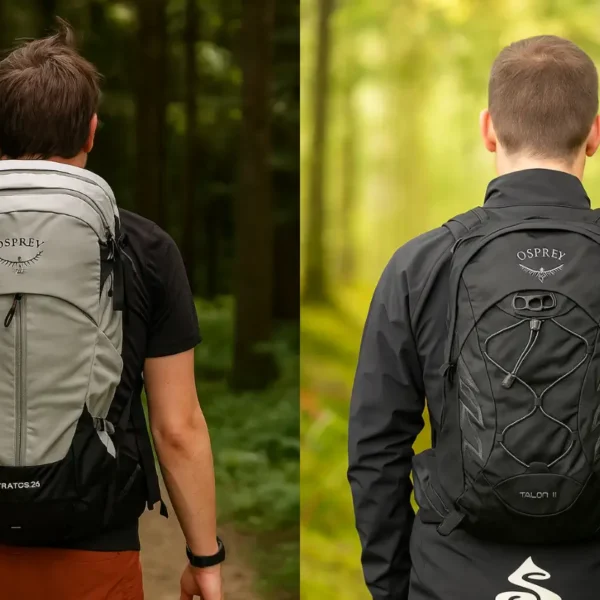
I’ve logged real miles with both Osprey and Gregory, from hot day hikes to 5-day carries. They solve the same problems in different ways. Osprey leans into ventilation and quick adjust. Gregory leans into cushioned support and hip-belt ergonomics.
I’ll compare how they fit, carry weight, breathe, organize gear, and hold up on the trail. No marketing—just what matters when you’re six hours in and the climb isn’t over.
What I’m Comparing
I’m looking at real trail use, not spec sheets. Daypacks like Osprey Stratos/Tempest vs Gregory Zulu/Jade. And multi-day haulers like Osprey Atmos/Aura vs Gregory Baltoro/Deva.
I’m judging how they fit different torsos, how the suspensions carry 20–50 lb, and how well they vent in heat. I’m comparing pocket layouts and access (panel vs top), hip-belt usability, and on-the-move tweaks.
I’m weighing build quality, noise, and durability over time. I’m also factoring rain covers, hydration setup, and warranty response. Price matters, but only when the carry and comfort hold up after six hours on trail.
Factors for Comparison
Here’s what decides it for me on the trail. Fit first. If the frame and hip belt don’t match my torso, nothing else matters. Then load transfer and stability at 20–50 lb. I want the weight on the hips, not my shoulders, and no sway on uneven ground. Venting is next in hot weather.
Access matters too—panel vs. top, and whether I can reach bottles and hip-belt pockets without stopping. I also watch hardware, fabric feel, and squeaks over time. Rain cover, hydration routing, and warranty support are tie-breakers. Price only counts after the carry is right.
Brand Snapshot
Here’s how I see the brands. Osprey builds around ventilation and polish. The carry feels sleek, the frames are tidy, and the pocketing is thought through. Their anti-gravity/airspeed meshes keep my back cooler than most. Gregory leans into load comfort.
The hips and shoulders feel cushier, and the suspension moves with me when the trail tilts. Osprey often runs lighter and more “tech.” Gregory feels more planted and forgiving under weight.
Both stand behind their gear well, but I reach for Osprey when I want max airflow and slick access, and Gregory when I expect heavier miles and rougher terrain.
Fit & Sizing Range
I fit Osprey and Gregory differently. Osprey gives me more on-pack torso adjustment across most lines. Slide, lock, done. Gregory tends to split sizes (S/M/L) and, on the bigger packs, lets me swap hipbelts and sometimes shoulder harnesses. That’s real customization.
On my body, Osprey’s hipbelt wraps and “grips” the iliac crest better if I’m in the overlap of two sizes. Gregory’s belts feel thicker and more forgiving, especially when the load creeps up. Women’s fits are solid on both brands; Osprey offers broader adjustability on day and mid-volume packs, while Gregory’s Deva/Baltoro class wins when I need a different belt length.
If I’m hard to fit (long torso, small waist, or the opposite), Gregory’s interchangeable parts save the day. If I’m within standard ranges or want fast, micro-adjustable setup on the trail, Osprey is simpler and quicker to dial.
Suspension & Load Transfer
Osprey feels springy and airy. The trampoline back panel spreads the load and keeps space for airflow, but it pushes the weight a touch farther from my spine. Great comfort, a little less direct control.
Gregory rides closer. The frame and pivoting hipbelt track my hips and dump more weight into the belt. It feels denser and more planted, especially past ~35–40 lb.
On rolling terrain, I prefer Osprey’s “floating” feel. When the pack is heavy or the trail is technical, Gregory’s tighter coupling gives me better balance and less shoulder creep.
Suspension & Load Transfer
Osprey feels springy and airy. The trampoline back panel spreads the load and keeps space for airflow, but it pushes the weight a touch farther from my spine. Great comfort, a little less direct control.
Gregory rides closer. The frame and pivoting hipbelt track my hips and dump more weight into the belt. It feels denser and more planted, especially past ~35–40 lb.
On rolling terrain, I prefer Osprey’s “floating” feel. When the pack is heavy or the trail is technical, Gregory’s tighter coupling gives me better balance and less shoulder creep.
Ventilation & Back Panel
Osprey moves the pack off my spine. The trampoline mesh breathes better than anything in this class. On hot climbs, sweat clears faster, and my base layer stays drier. The trade-off is distance from the chassis—you feel the load sit a bit farther back.
Gregory rides closer. The mesh and channels vent well, but it’s warmer than Osprey on humid days. The upside is control: the pack tracks my back, keeps the center of gravity tight, and creaks less under torque.
In shoulder season, I prefer Gregory—less draft across my lumbar and fewer cold spots. In midsummer heat or desert sun, Osprey’s airflow wins by a mile.
Load Range & Stability
Osprey feels best in the mid-weights. Think 20–35 lb. The frame and hip wrap spread the load cleanly, but the airy back panel pushes weight a touch rearward. On a smooth trail, it’s fine. On boulders or side-hills, I notice a little sail effect unless I cinch it hard.
Gregory likes real weight. At 35–50 lb it settles onto the hips, rides closer, and stays quieter. Less sway. Better fore-aft control when you scramble or take big steps. The trade-off is heat and a slightly denser feel at low loads.
If I’m carrying water for a dry camp or a bear can, I pick Gregory. If it’s a fast overnight with a tight, light kit, Osprey moves faster and still feels planted.
Access & Organization
Osprey gives me more doors into the bag. Big front J-zip/U-zip on the Baltoro-equivalent Atmos, a true sleeping-bag hatch on Stratos/Atmos, and plenty of small stash spots. The Stow-on-the-Go pole loops are fast when I hit a scramble.
Hip-belt pockets are okay, but not huge. Bottle pockets work, yet sit a bit rearward on the ventilated frames, so I usually tilt the pack or use a hose.
Gregory runs simpler and faster. Zulu/Miko panel access is clean, with a generous front shove-it pocket that swallows a wet shell. The SideWinder bottle pocket is actually reachable while walking. Hip-belt pockets are larger, so a big phone fits without wrestling zippers.
On the big packs, the Baltoro’s full U-zip is king for camp setup—I can lay the pack flat and unload in order. Fewer fiddly compartments, less digging, quicker transitions.
Hydration & Water Carry
I give Gregory the edge for on-trail drinking. Their 3D Hydro bladder with the SpeedClip hanger clicks in one-handed, doesn’t slump, and drains clean. Hose routing is simple and the tube keeper on the strap actually holds. The SideWinder bottle pocket is the real win—it’s angled, reachable while walking, and swallows a 1–1.5 L without a fight.
Osprey’s Hydraulics bladder is solid too. The stiff backer keeps the bag from taco-ing and slides into the sleeve easily. Bite-valve magnets on some harnesses are convenient. But on the ventilated frames the side pockets sit farther back, so grabbing a bottle mid-stride takes a tilt or a quick stop. For pure reservoir use, both work. For bottles on the move, Gregory is faster.
Weight & Materials
Osprey usually comes in lighter for the volume. The frames and harness foam are trimmed, and the chassis uses smart cutouts to save grams. Gregory tends to run a touch heavier, but the fabrics and hardware feel denser and tougher in the hand.
On shell cloth, Osprey leans into lighter recycled nylons with PFC-free DWR. Great for the scale, fine for normal trail use. Gregory often specs higher-denier panels in wear zones and thicker webbing. That pays off when you’re scraping rock or bushwhacking.
Frames differ too. Osprey’s hollow wire + tensioned mesh keeps weight down. Gregory’s alloy stays and beefier hipbelt laminate add grams but improve long-term shape retention under load.
Osprey’s lighter build suits hikers who value efficiency and low weight. Gregory’s denser materials and tougher fabric deliver better long-term durability and abrasion resistance.
Durability & Repair
I’ve had fewer fabric failures with Gregory. Their denser nylons, beefier hipbelts, and bartacked lash points take abrasion and overstuffing better. Frames stay quiet longer, too; fewer squeaks under load. Osprey’s lighter shells scuff sooner, especially on granite and deadfall, but the hardware is excellent, and zips rarely give up.
For repairs, Gregory’s panels are easier to patch cleanly because they stretch less and hold tape well. Osprey wins on spare-part availability: buckles, sternum sliders, and hipbelt pockets are easy to source and swap. Mesh back panels are the weak link on both; once torn, stitch-reinforce early before it ladders. For warranty work, both brands are responsive; in my experience, Gregory fixes more, Osprey replaces more.
Weather Protection
Both brands lean on DWR fabrics, but neither pack is “rainproof.” Seams and zips will wet out in sustained rain. Osprey more often includes an integrated rain cover in its trekking lines. Gregory varies by model and year.
Storm flaps on both help for showers; panel loaders take on water faster if you open them mid-drizzle, while top loaders with lids shed better. I treat the fabric early, carry a cover, and stash wet layers in the front shove-it pocket. That routine works the same on Osprey and Gregory.
On-Trail Handling
On the move, Osprey feels springy and eager. The frame rebounds when I hop rocks and the pack stays centered through quick pace changes. Gregory feels calmer. The load tracks my hips and the sway is muted on side-hills. Pocket access matters mid-stride: Osprey’s hip pockets open easier with one hand; Gregory’s are larger and swallow a big phone without fuss.
Pole carry is faster on Osprey when I stash and go; Gregory is cleaner once everything’s lashed. Under heavier loads I notice fewer creaks from Gregory; Osprey can chirp a bit until the straps settle. When the trail turns scrambly, Osprey wins for agility; on long, rough descents Gregory wins for composure.
Travel & Everyday Use
For airports and city days, Osprey is fuss-free. The frames are slimmer, slide into overheads easier, and the top pockets keep passport and headphones ready.
The Stow-on-the-Go pole loop doubles as a quick umbrella stash when it’s drizzling curbside. Gregory feels more “everyday tough.” The fabrics shrug off luggage belts and taxi trunks, and the hip-belt pockets actually fit a big phone and wallet without bulging.
Panel-loader Gregory daypacks give faster hotel-room access; Osprey lid-style daypacks feel tidier when I’m sprinting between gates. For long terminal walks, Osprey breathes better; for rough commutes and knocks, Gregory stays cleaner and quieter.
Price & Value
Osprey starts lower in price and stays consistent across its lines. The Daylite and Arcane packs are affordable, usually under $130, and often go on sale.
They feel premium for the price — lightweight, tidy, and reliable for years. Gregory costs more upfront, especially for the hiking and backpacking range. The Zulu and Jade run around $229, while the Paragon and Maven sit closer to $270.
But the build feels tougher, and the suspension is more refined. Osprey gives you value through features and versatility; Gregory delivers it through structure and longevity. For me, Osprey wins on price efficiency, Gregory on long-term durability.
Size & Model Picker
For everyday carry and short hikes, I stick with Osprey. The Daylite and Arcane lines are light, compact, and built for quick grab-and-go use. They ride comfortably even when nearly empty, which makes them ideal for travel or commuting.
Once I’m packing more gear, Gregory starts to stand out. The Zulu and Jade offer better load control and ventilation in the 30–45L range — the difference shows once you’re carrying real weight. For multi-day hikes, the Paragon and Maven stay stable even when packed full.
In short, Osprey is my choice for compact mobility. Gregory is what I reach for when the trip gets longer and the load gets heavier.
Final Verdict
For day-to-day carry and short hikes, I reach for Osprey. The Daylite and Arcane lines are simple, light, and priced fairly—great value for commuters and travelers who want a clean, no-fuss pack.
For real trail miles and heavier kits, I go Gregory. Zulu/Jade give me better load control and ventilation in the mid-volume range, and Paragon/Maven stay stable when fully packed. The price jump over basic daypacks makes sense once you’re hauling food, water, and layers for hours.
Osprey for everyday mobility and budget-friendly versatility; Gregory when support and on-trail comfort matter more than saving a few ounces or dollars.
Leave a Comment