
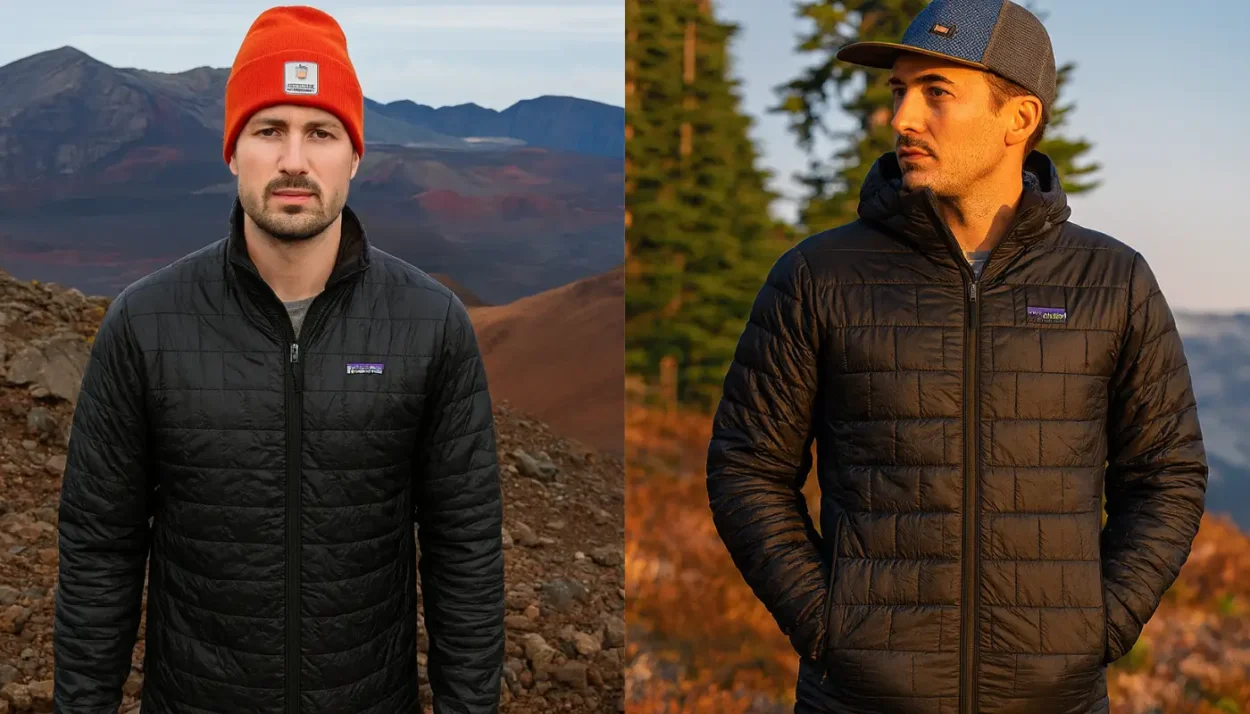
I’m putting the Patagonia Nano Puff Jacket against the Patagonia Down Sweater, same size, non-hooded, used on the same trails. The Nano Puff runs 60 g PrimaLoft Gold Eco in a 20D ripstop shell and stuffs into its own pocket.
The Down Sweater uses 800-fill down in a lightweight recycled shell and also self-stows. I wear both as midlayers under a shell and as stand-alone pieces in shoulder season. One favors damp tolerance and steady movement; the other is about pure loft for cold, dry pauses.
What I’ll Judge Them On
For this matchup I focus on real trail priorities: warmth per weight at rest, performance when damp, wind hold, and how cleanly each layers under a hardshell. I also pay close attention to pocket height with a hip belt, zipper reliability, and how small they pack.
In short: the Down Sweater must justify its loft and price with superior static warmth and efficient baffles; the Nano Puff must prove its value in mixed, wet-cold hikes—steady warmth when you’re moving, tolerant of drizzle, and zero fuss under a pack and shell.
If a jacket can’t stay comfortable across start-stop pace, stuff neatly into its own pocket, and avoid snaggy zips or bulky seams, it doesn’t make my cut.
Wet-weather reality
Neither jacket is waterproof. Both have DWR that beads off a quick shower, then they wet out. In real rain, I always add a shell.
The Nano Puff handles moisture better. Synthetic PrimaLoft keeps insulating when damp and it dries fast in a hut or car with minimal heat. I can keep moving and stay reasonably warm, even if the face fabric is soaked.
The Down Sweater is different. Once the down takes on water, loft drops and warmth falls off a cliff. It also takes much longer to dry. Light mist is fine; sustained drizzle is not.
For mixed, wet-cold hikes, Nano Puff under a hardshell is the safe play. The Down Sweater needs that same shell, but it’s far less forgiving if you get caught without it.
Price & Value
Here’s how I see the dollars. Nano Puff is the cheaper system: the standard jacket sits at about $229, the Hoody at $289, the Hi-Loft Hoody at $329, and the vest around $189. Colors and retailers can nudge that up or down. The Down Sweater lives a tier higher: the men’s and women’s jackets are usually $279, the Hoody $329, the vest $229, and longer or specialty pieces like the women’s Recycled Down Sweater Parka hit about $359.
Kids’ Down Sweaters swing widely—roughly $70 to $139. Sales do happen. I’ve seen the Down Sweater Hoody dip to about $197.40 at Backcountry. Net-net: if I want maximum value for a wet, mixed season, I grab the Nano Puff line. If I’m chasing warmth-to-weight for cold, dry trips and plan to keep it for years, I pay up for the Down Sweater, then watch for a smart discount.
Cold-weather insulation
When it’s truly cold and dry, the Down Sweater wins. The 800-fill down traps more heat with less bulk and feels instantly warmer at camp or on slow, windy ridgelines. It also rebounds loft quickly after being stuffed. The Nano Puff hangs in for shoulder-season hikes and damp, mixed weather.
Its 60 g synthetic fill keeps delivering heat even if the face fabric wets out, but it can’t match the cozy, at-rest warmth of the Down Sweater. If it’s dipping below freezing, I grab the Down Sweater. Hooded if I can. Then I throw a shell over it.
When the trail turns wet and weird, I switch to the Nano Puff. It’s just more forgiving when things get sloppy.
Key differences
For pure warmth at camp, the Down Sweater wins. More loft, warmer at rest, especially with the hood. The Nano Puff is the safer bet when things get wet or sloppy. Its synthetic fill keeps working after drizzle or sweat. The Down Sweater feels cozier in dry cold, but it loses ground fast if it gets damp.
Packability is close, but the Nano Puff stuffs smaller and weighs a touch less. The Down Sweater breathes a touch better when I’m just cruising. The Nano Puff feels more sealed and shrugs off gusts on its own. Day to day, the Nano’s face fabric feels tougher; the Down Sweater’s shell is lighter and needs a bit more care around packs and brush.
I grab the Down Sweater for cold, dry trips and true sub-freezing nights. I grab the Nano Puff for shoulder seasons, mixed weather, and any hike where wet snow or light rain might show up.
Leave a Comment