

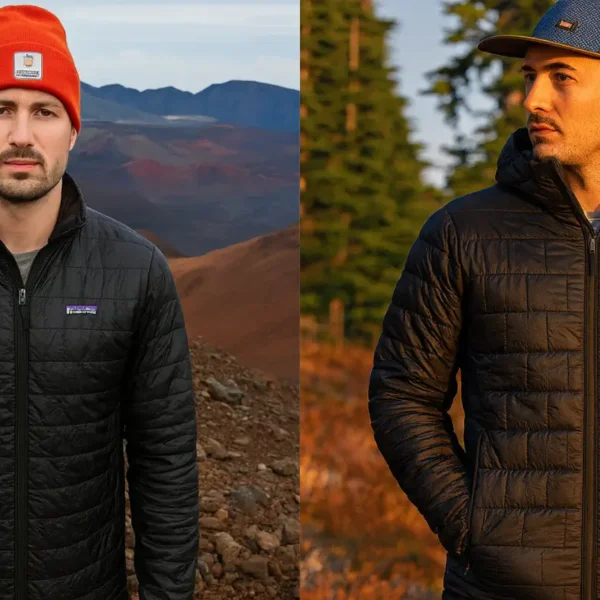
I’m putting the Patagonia Micro Puff Hoody head-to-head with the Nano Puff (both the hoody and the jacket). The Micro Puff uses PlumaFill in a 10D ultralight shell and stuffs into a hand pocket with a clip loop; the Nano Puff uses PrimaLoft Gold Eco in a tougher-feeling 20D shell and packs into its chest pocket.
Pocket layouts differ too—Micro’s higher hand pockets and big internal drop pockets vs the Nano’s lower hand pockets and an internal zip chest pocket.
Both are synthetic, DWR-treated midlayers I hike in and throw under a shell; I just reach for them for different kinds of days.
Key Factors For Comparison
I judge these two on trail-use basics: warmth-to-weight, durability, packability, pocket layout, and wind handling. The Micro Puff is my ounce-counter—lighter 10D shell, higher warmth per gram, and it stuffs smaller into its hand pocket. The Nano Puff feels tougher in the hand with its 20D face and lower, more casual hand pockets; it’s the one I don’t baby around packs, rocks, or camp chairs.
Micro’s high pockets clear a hipbelt, and it adds big internal drop pockets—great for gloves and drying filters—while the Nano gives me an internal zip chest pocket I actually use for phone and keys. In steady wind, both need a shell, but the Nano’s slightly denser face fabric blunts gusts a touch better; the Micro runs a bit loftier and warmer for the weight.
Zippers matter too: the Micro’s tiny coil saves grams but snags easier; the Nano’s hardware is less fussy with cold fingers. That’s the lens I use when deciding which one leaves the house.
Weather Protection
Neither of these is a storm shell, and I treat them that way. In drizzle or wet snow, both bead for a short window thanks to the DWR; after 15–30 minutes the fabric wets out at seams and the cuffs, so I throw a hardshell on. In steady wind, the Nano Puff’s denser 20D face feels a touch less drafty when I’m standing around at a belay or a viewpoint.
The Micro Puff blocks about the same while moving, but its 10D shell lets more air sneak through if I stop on a ridgeline. In mixed, shoulder-season mess—spitting rain, gusts, damp brush—I can hike comfortably in either for a bit, but the rule is simple: puffy for warmth, shell for weather.
The hooded versions buy me extra margin in graupel and crosswinds, yet for any sustained wet, I always layer a rain shell over the top.
Insulation & Perceived Warmth
On body, the Micro Puff feels loftier and “warmer-per-ounce.” PlumaFill traps heat fast, so when I stop for a snack or a summit photo, it takes the edge off quicker than the Nano Puff. The Nano’s PrimaLoft Gold Eco is solid and a touch flatter; warmth is close, but the Micro carries a slight advantage at rest.
While moving, both are mid-weight puffies—you’ll overheat if you push. The difference I feel is in how they hold heat between efforts: the Micro Puff keeps a cozier microclimate, whereas the Nano can feel a bit clammy if I’m running warm and then cool down.
Wind changes the math. Without a shell, the Nano’s denser face fabric leaks less air, so it can feel warmer on a breezy ridge even if the fill isn’t as lofty. Add a hood to either and the perceived warmth jumps notably (big payoff for the weight).
Micro Puff for maximum loft and fast warmth at breaks; Nano Puff when I expect more breeze and want that slightly “tighter” exterior to help it feel warmer in the wind.
Breathability & High-Output Use
Neither of these is a true “active insulation” piece, so on steep climbs I overheat in both and end up unzipping or stashing them. That said, the Micro Puff breathes a touch better in my experience—its lighter face fabric and quilting seem to dump heat a bit quicker when I surge, then settle.
The Nano Puff runs tighter and can feel swampy sooner if I’m power-hiking or skinning with a pack. On stop-and-go days, the Micro smooths those transitions; I can keep it on longer with the front zip cracked and not get soaked. For continuous high output, I still switch to a breathable mid (Atom/Nano Air class) and keep either Puff for breaks and descents.
Weight & Packability
On the scale, the Micro Puff wins. It’s about an ounce or two lighter in my sizes and it feels that way in hand. It also stuffs into its hand pocket with a little hang loop, so I can clip it to a pack if I’m moving fast. The Nano Puff packs small too, but into the chest pocket and as a squarer bundle.
It’s a touch heavier and, for me, a bit easier to stuff back in—less fighting the zipper. In a backpacking kit where every gram matters, I grab the Micro. For travel or daily carry, the Nano’s neater, brick-like pack shape is slightly nicer to live with.
Fit, Hood & Mobility
On me, the Micro Puff runs trimmer and moves better. Overhead reaches don’t tug the hem, and the shoulders feel freer when I’m scrambling or setting a stove. The Nano Puff is a touch boxier and easier to layer over a fleece, but it doesn’t “disappear” quite the same when I’m moving fast.
Pocket height matters. The Micro’s hand pockets sit higher, so a hip-belt or harness doesn’t block them. The Nano’s are lower and more natural for casual use.
Hoods are different, too. The Micro Puff hood is snug and helmet-friendly; it seals heat and turns with my head, though it muffles hearing a bit. The Nano Puff’s collar (and its hooded version) feels more relaxed and nicer around town, but it’s not as locked-in in wind.
Hem drawcords and elastic cuffs work on both, but the Micro’s trim cut plus lighter fabric gives me cleaner arm swing.
For pure mobility, I reach for the Micro. For everyday layering comfort, the Nano is easier.
Features Snapshot
Here’s what stood out in real use. Micro Puff: trimmer cut, shinier 10D Pertex face, higher hand pockets that stay usable under a hip-belt, and those huge internal drop pockets I actually stash gloves and a filter in. It stuffs into the left hand pocket and hangs from the sewn loop—handy on a pack. Zips are tiny and can snag if I rush.
Nano Puff: slightly boxier cut, tougher-feeling 20D polyester face with a matte look, lower hand pockets that feel natural around town, plus a zippered internal chest pocket I prefer for phone/ID. It stuffs into its chest pocket cleanly and the main zip feels more forgiving with cold hands.
Both have DWR, elastic cuffs, hem cinches, and hooded versions. For pure utility on trail, the Micro’s pocket layout wins. For everyday carry and simplicity, the Nano’s pocket set and sturdier shell are easier to live with.
Durability & Сare
Out on trail, the Nano Puff feels tougher. The 20D polyester face shrugs off pack straps and trail rub better, and the main zip is less fussy. My Micro Puff is lighter but more delicate—the 10D Pertex can snag on brush and the tiny zips will bite fabric if I rush them. I baby it around granite and use a shell if I’m bushwhacking or shouldering a heavy load.
Both handle occasional damp just fine, but neither likes sparks. I scorched a Nano sleeve at a fire; Tenacious Tape fixed it in seconds and it’s held for years. I’ve also trimmed stray threads on the Nano; no failures, just housekeeping.
For care, I wash sparingly on cold, tumble low with a couple clean tennis balls, and revive the DWR with a quick low-heat pass. Most days I store them loose on a hanger—stuff sacks are for trips, not long-term. If something does let go, Patagonia’s repair program is worth using.
Price & Value
I pay more for the Micro Puff ($279). That premium buys best-in-class warmth-to-weight, the smallest packed size, and—judging by user feedback—a slight edge (4.4/5 from 72 reviews). When I’m counting ounces or cramming a single puffy for long hikes, the extra cash makes sense.
Day to day, the Nano Puff ($229) is the better deal. It’s usually cheaper, pops up on sale more, and its 20D shell and friendlier zips feel more “daily driver.” Reviews back that up well enough (4.2/5 from 18 reviews). Add the chest pocket and easier care, and cost per use tilts Nano unless I truly need ultralight performance.
Gram-weenie trips = Micro Puff; everything else—especially town-to-trail use—Nano Puff to save money without giving up much warmth.
Key Differences
Micro Puff is the specialist. It’s lighter, packs smaller, and feels warmer for the weight thanks to PlumaFill and that minimal quilting. Hand pockets sit higher for a hip-belt, and it stuffs into its own pocket cleanly. The tradeoff is the 10D shell. It’s fast and light, but easier to scuff and the tiny zips can snag.
Nano Puff is the generalist. The 20D face feels tougher day to day, the zips are friendlier, and the lower hand pockets are simply nicer around town. Warmth is close, but it carries a bit more bulk and doesn’t compress as tightly.
My take is simple. If I’m ounce-counting or space-limited, I grab the Micro and don’t look back. If I’m mixing trail with travel and want fewer worries about abrasion, I wear the Nano and pocket the savings. Either way, they’re midlayers—not rain shells—so pair them with a hardshell when the weather turns.
Leave a Comment