
Whether you’re an avid hiker, an outdoor enthusiast, or a curious adventurer, navigation skills are essential. They not only guide you to your destination but also ensure your safety. In this digital age, while GPS and smartphone apps are handy, traditional navigation tools like a map and compass are reliable, battery-free backups. Plus, understanding natural navigation cues can be a lifesaver when technology fails. So, let’s dive into the world of navigation. 🌲
Understanding the Basics of a Compass
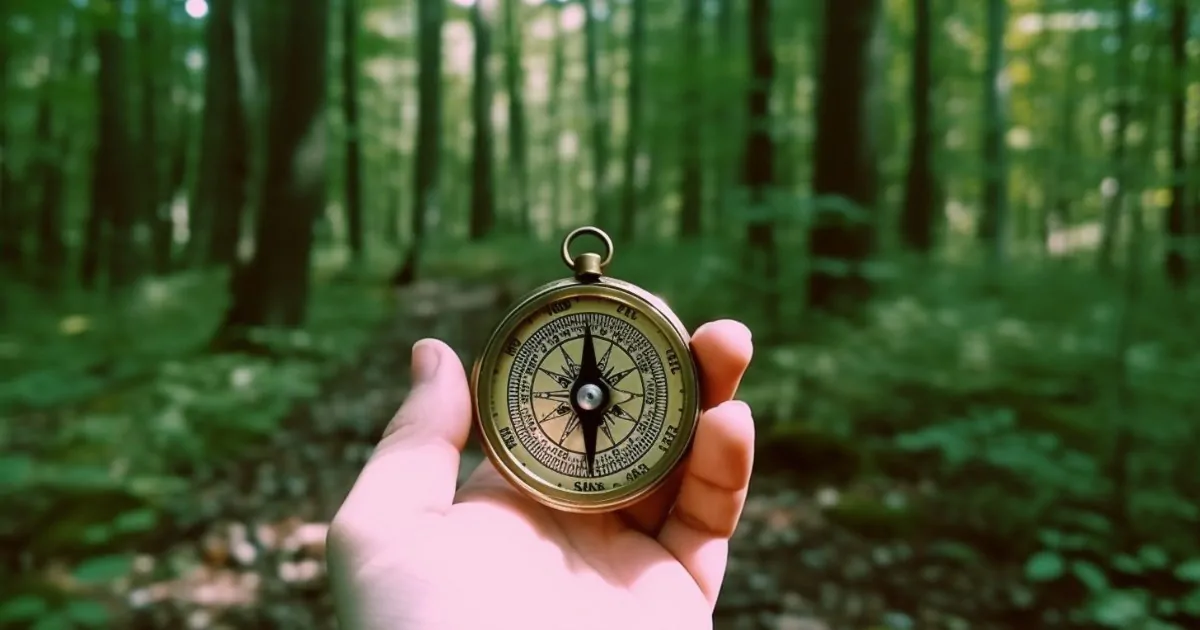
A compass, a small tool with a magnetic needle, is your best friend when it comes to finding your way. The needle, attracted by the Earth’s magnetic field, always points towards the magnetic North. The compass dial is divided into 360 degrees, providing a detailed direction. The four cardinal points – North (N), South (S), East (E), and West (W) – are your primary guides. But, how do you use this tool effectively? Let’s find out.
Reading a Compass
Hold the compass flat in your hand at your chest level. Ensure the direction of travel arrow points straight ahead. Now, turn yourself until the magnetic needle aligns with the orienting arrow (also known as putting ‘Red in the Shed’). Voila! The direction of travel arrow now points to your true heading. Remember, the compass doesn’t know your destination; it merely points to the magnetic North. It’s your job to determine the right direction based on this information.
Setting a Bearing
Setting a bearing helps you navigate from one point to another. First, find your current location and your destination on the map. Draw a straight line between these points. Now, place your compass on the map so that the edge of the baseplate connects the two points, with the direction of travel arrow pointing towards your destination. Rotate the compass dial until the orienting lines align with the map’s north-south grid lines. The number indicated at the direction of travel arrow is your bearing. Transfer this bearing to your compass, and follow the direction of travel arrow. You’re on your way!
Reading a Map: Symbols, Scales, and Grids

Maps are a treasure trove of information, providing a bird’s-eye view of the terrain. They contain symbols, scales, and grids that, once understood, can help you navigate effectively.
Deciphering Map Symbols
Map symbols are the language of maps. They represent real-world features like trails, campsites, water bodies, and contour lines. Each map comes with a legend or key, a cheat sheet that explains what each symbol means. Familiarize yourself with these symbols to understand the terrain better.
Understanding Map Scales
A map scale is a ratio that represents the relationship between a distance on the map and the actual distance on the ground. For instance, a scale of 1:50,000 means that 1 cm on the map equals 50,000 cm (or 500 meters) in real life. A smaller scale map (like 1:100,000) shows a larger area with less detail, while a larger scale map (like 1:24,000) shows a smaller area with more detail. Understanding the scale helps you estimate distances and plan your route.
Grasping Grid References
Grid references help you pinpoint exact locations on a map. Maps are crisscrossed with vertical (north-south) and horizontal (east-west) lines, creating a grid. Each grid square has a unique reference number, usually given as a pair of numbers. The first number (eastings) corresponds to the horizontal lines, and the second number (northings) corresponds to the vertical lines. By knowing how to read grid references, you can locate features on a map or communicate your location in an emergency.
Combining Compass and Map: Orienting and Route Planning
While a compass and a map are powerful tools individually, combining them unlocks their full potential. Orienting your map, i.e., aligning it with the actual landscape, helps you visualize your surroundings better. Simply align the compass needle with the north on the map, and your map is oriented!
When planning your route, identify your start and end points and any significant features along the way. Use your compass to take bearings from one point to another and follow them. Remember to adjust for magnetic declination, the difference between magnetic north (where your compass points) and true north (the North Pole).
Natural Navigation: Using the Sun, Stars, and Landmarks

While compasses and maps are indispensable navigation tools, nature provides its own set of cues. The sun, stars, and even the landscape itself can guide you on your way. Let’s explore how. ☀️
Sun Navigation
The sun, our very own celestial compass, rises in the east and sets in the west. At noon, it’s roughly due south in the northern hemisphere and due north in the southern hemisphere. By observing the sun’s position, you can estimate the cardinal directions. But remember, the sun’s path changes with the seasons, so use it as a general guide rather than a precise tool.
Star Navigation
On a clear night, the stars can be your guide. In the northern hemisphere, the North Star (Polaris) indicates true north. Locate the Big Dipper constellation, find the two stars forming the outer edge of its ‘dipper’, and follow their line upwards to find Polaris. In the southern hemisphere, the Southern Cross constellation points the way. Draw an imaginary line through the long axis of the Southern Cross, and extend it about four and a half times to find south.
Landmark Navigation
Landmarks, or easily recognizable features in the landscape, can also aid in navigation. Mountains, rivers, unique rock formations, or even man-made structures can serve as reference points. By knowing your position relative to these landmarks, you can maintain a sense of direction. But remember, always use reliable and fixed landmarks that won’t change over time.
Practical Tips for Effective Navigation

Now that we’ve covered the basics, here are some practical tips to hone your navigation skills.
Practice Makes Perfect
Like any skill, navigation improves with practice. Start in familiar areas, gradually venturing into new terrains. Use your compass and map on regular hikes, practice estimating distances, and try identifying landmarks. The more you practice, the more confident you’ll become.
Stay Aware of Your Surroundings
Navigation is about awareness. Pay attention to your surroundings, observe changes in the landscape, and regularly check your map and compass. Don’t just rely on marked trails; look for other features that can guide you. Remember, the goal is not just to reach your destination, but also to understand the journey.
Always Have a Backup
Even the best navigators can get lost or face equipment failure. Always carry a backup compass and map, and know the basics of natural navigation. And most importantly, let someone know your planned route and expected return time before you set off.
Trust Your Tools, But Use Your Judgment
Compasses and maps are reliable, but they’re not infallible. Magnetic fields can affect compass readings, and maps may not always reflect recent changes in the landscape. Use your tools as guides, but also trust your judgment and intuition. If something doesn’t feel right, stop, reassess, and if necessary, seek help.
Learn from Mistakes
Getting lost is not a failure; it’s a learning opportunity. If you take a wrong turn, don’t panic. Instead, try to understand what went wrong. Did you misread the map? Did you take an incorrect bearing? Use these experiences to improve your navigation skills. Remember, every great navigator has been lost at some point!
Frequently Asked Questions
1. Why is it important to learn traditional navigation skills in the age of GPS and smartphones?
While GPS and smartphones are convenient, they rely on batteries and satellite signals, which can fail or be unavailable in remote areas. Traditional navigation skills using a map and compass are reliable, don’t require batteries, and work anywhere. Plus, they help you understand the landscape better and can be a lot of fun!
2. How accurate is sun and star navigation?
Sun and star navigation can provide general directions and are useful when other methods are unavailable. However, they’re not as precise as a compass and map, and their accuracy can be affected by the time of year and your geographical location.
3. What is magnetic declination and why is it important?
Magnetic declination is the difference between magnetic north (where the compass needle points) and true north (the North Pole). It varies depending on where you are on the Earth. When navigating over long distances, not accounting for declination can lead to significant errors, so it’s important to adjust your compass accordingly.
4. I got lost while navigating. What should I do?
First, don’t panic. Stop, sit down, and try to calm yourself. Check your map and compass and try to identify any recognizable landmarks. If you still can’t determine your location, stay where you are, especially if it’s late or the weather is bad. Use a whistle or a mirror to signal for help. If you have a cell phone and reception, call for help.
5. How can I improve my navigation skills?
Practice, practice, practice! Start in familiar areas and gradually venture into new terrains. Use your compass and map on regular hikes, practice estimating distances, and try identifying landmarks. You can also take navigation courses or join orienteering clubs to learn from experienced navigators.
Conclusion
Navigation is more than just getting from point A to point B. It’s about understanding the landscape, interpreting nature’s cues, and making informed decisions. It’s a skill that fosters awareness, builds confidence, and deepens your connection with the outdoors. So grab your compass, unfold your map, and step into the world of navigation. You’ll discover that the journey can be as rewarding as the destination. Are you ready to navigate your next adventure? 🏞️

Leave a Comment